
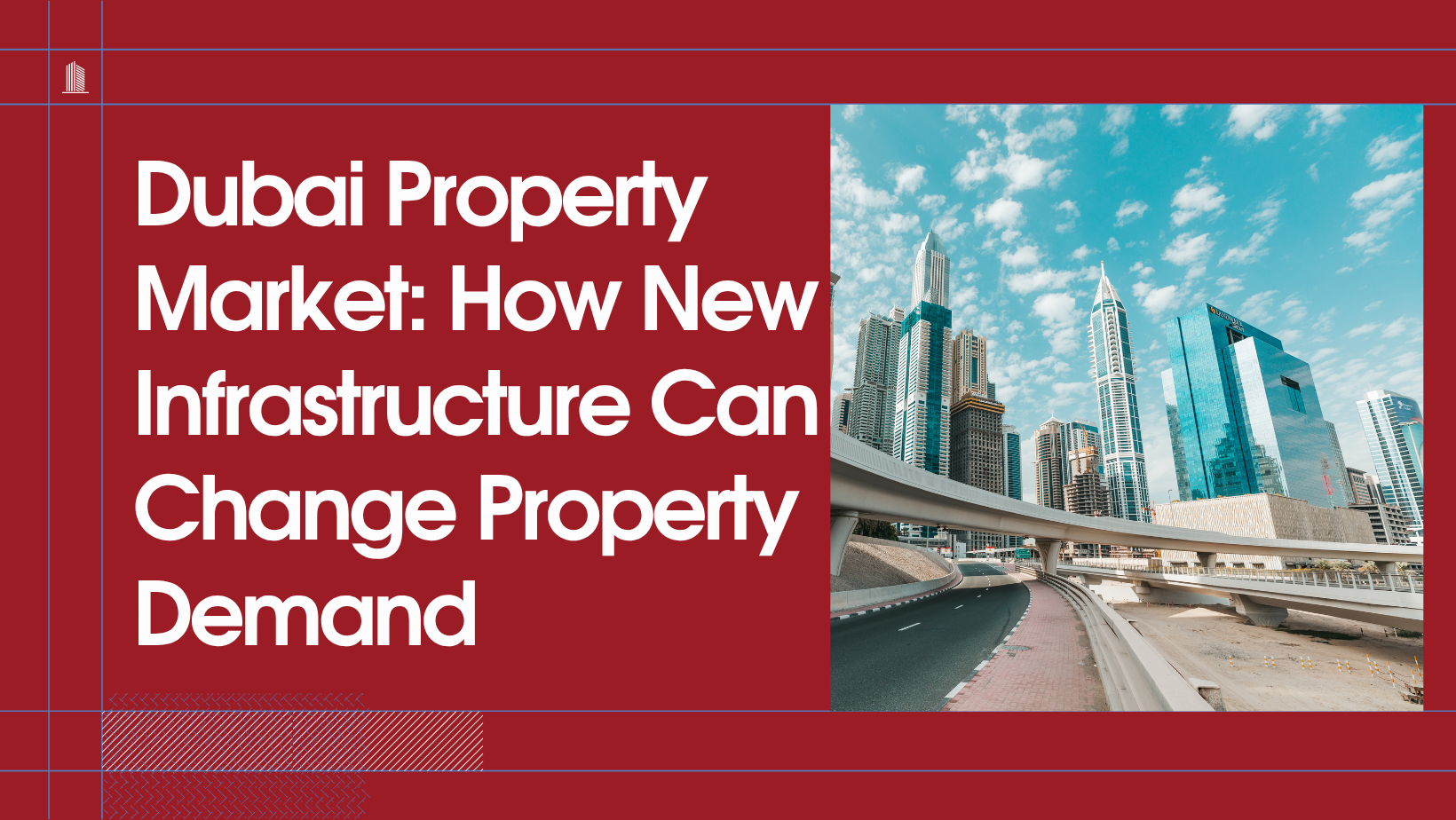
Dubai Property Market: How New Infrastructure Can Change Property Demand
A property does not exist in isolation. What surrounds it can influence how people use it, how easily they can reach it and how much demand it attracts.
That is why infrastructure deserves closer attention when evaluating the Dubai Property Market. A new metro line, road connection, school, hospital, retail district or pedestrian network can change how residents experience an area. It can also influence where businesses operate and where buyers and tenants choose to live.
Infrastructure does not automatically increase property value. Its impact depends on what is built, where it is located, when it becomes operational and whether actual demand follows. For buyers considering the Dubai Property Market, the key is to understand the connection between infrastructure and real demand.
Quick Answer: How Can Infrastructure Affect Property Demand?
Infrastructure can influence the Dubai Property Market by improving accessibility, reducing travel time, supporting new communities and making locations more convenient for residents and businesses.
Transport infrastructure can have a visible effect. This is one reason the Dubai Property Market is closely watched around major connectivity projects. Dubai’s Roads and Transport Authority has linked transport infrastructure with changes in property values, while current projects show how mobility remains central to Dubai’s urban development.
For Dubai property investment, infrastructure is one factor within a wider assessment of location, supply, demand, property quality and timing.
Explore Dubai Property Opportunities
Compare properties based on location, infrastructure, connectivity and your investment goals.
1. Better Connectivity Can Expand an Area’s Buyer Pool
When a neighbourhood becomes easier to reach, it can become practical for people who previously considered it too far from work, schools, entertainment or daily services.
This matters when people buy property in Dubai because they are not simply buying a home. They are also buying access to the wider city.
A property with convenient connections to employment centres, schools, retail and leisure destinations can appeal to a broader group of residents. For buyers considering property in Dubai price, those connections can be an important comparison point.
The same applies to investment property in Dubai. For investment property in Dubai, tenant preferences can make accessibility a practical demand driver.
2. Metro Expansion Can Change the Location Story
Dubai’s expanding metro network provides a useful example of how infrastructure can reshape the Dubai Property Market.
The Dubai Metro Blue Line is currently under construction. RTA says it spans 30 kilometres and includes 14 stations, connecting nine key districts and supporting an estimated population of around one million by 2040. The line is scheduled to open on 9 September 2029 and will connect with the existing Red and Green Lines. (RTA)
The planned Gold Line is another major development. RTA says it will extend 42 kilometres with 18 stations and is scheduled for inauguration on 9 September 2032. (RTA)
These projects can change how people view connected areas and reshape parts of the Dubai Property Market, but there is an important distinction:
A planned station is not the same as an operating station.
When considering Dubai property investment, buyers should look at the confirmed route, construction stage, expected completion and the development taking place around it.
3. Roads Can Change More Than Commute Times
Not every infrastructure story is about metro stations.
Road improvements, bridges, junction upgrades and new connections between communities can reduce travel times and improve accessibility. This can make previously less convenient areas more practical for residents and businesses, helping the Dubai Property Market attract new demand.
When evaluating the Dubai real estate market, ask what the infrastructure actually changes. This approach also helps interpret the Dubai real estate market beyond headline announcements.
Does it connect the area to a major employment corridor?
Does it improve access to the airport?
Does it reduce congestion?
Does it make another part of Dubai easier to reach?
4. Infrastructure Can Create a Wider Ecosystem
Property demand does not depend on transport alone.
A neighbourhood can become more useful when transport is supported by schools, healthcare, retail, hospitality, offices, parks and other services. This wider ecosystem can strengthen the Dubai Property Market as residents gain more reasons to live, work and spend time in the same area.
Over time, an area can shift from somewhere people pass through to somewhere people choose to live.
That wider ecosystem can be particularly relevant for investment property in Dubai, because residents have multiple reasons to remain in the area.
5. The Blue Line Shows Why Timing Matters
The Dubai Metro Blue Line is a useful example of why timing matters when evaluating property in Dubai price.
RTA says the project will serve nine areas with a projected population of around one million by 2040. It will connect Dubai Creek Harbour, Ras Al Khor, International City, Dubai Silicon Oasis, Academic City, Mirdif and other areas, while providing connections to Dubai International Airport.
RTA also states that the Blue Line is expected to support a 20-minute city concept and could increase land and property values around stations by up to 25%. This is an official projection, not a guarantee for individual properties.
Anyone planning to buy property in Dubai should therefore avoid taking a projected uplift and applying it directly to an apartment.
Actual property in Dubai price depends on several factors, including building quality, layout, views, supply, demand, condition and proximity to completed infrastructure. Buyers should remember that property in Dubai price is not determined by infrastructure alone.
6. Walkability Is Becoming Part of the Infrastructure Story
Connectivity does not end at a metro station.
In July 2026, RTA approved a five-year soft mobility plan covering 25 residential areas and infrastructure around 63 public transport stations through 2030. The plan aims to strengthen first- and last-mile connections between residential areas and public transport.
Better pedestrian and cycling infrastructure can make public transport more useful and improve everyday convenience.
For people looking to buy property in Dubai, this can become another factor to compare alongside parking, road access and distance to major destinations.
7. Infrastructure Can Attract More Than Residents
Improved infrastructure can also influence commercial activity.
Better connectivity can make it easier for employees to reach offices, customers to visit businesses and companies to access different parts of the city.
That can create additional demand around mixed-use developments and residential areas close to employment centres.
This relationship matters when analysing the Dubai real estate market because residential demand and economic activity can develop together. That connection is useful when studying the Dubai real estate market across different districts.
For someone considering Dubai property investment, it can therefore be useful to ask:
What economic activity is developing around this property?
Not just:
Who will live here?
What Should Buyers Actually Check?
Infrastructure can create an opportunity, but it should not become the only reason to purchase a property.
Before making a decision, check:
- What infrastructure is already operational?
- Which projects are officially approved?
- What is the expected completion date?
- How close is the property to the actual connection?
- What will the project improve?
- Is new residential supply coming into the area?
- Are schools, retail and healthcare developing alongside it?
- Is current demand already visible?
This is particularly useful when comparing property in Dubai price across different locations.
A lower-priced property near planned infrastructure is not automatically better value than an established property with proven connectivity.
Infrastructure Does Not Affect Every Property the Same Way
The impact can vary depending on the property type. That is important because the Dubai Property Market does not respond uniformly to every infrastructure project.
Apartments: Connectivity can matter strongly to professionals and tenants who commute. That makes investment property in Dubai particularly sensitive to practical access.
Family homes: Schools, roads, parks and everyday services may carry more weight.
Commercial property: Access for employees, customers and logistics can influence demand.
Off-plan projects: Future infrastructure can strengthen the location story, but timing and execution become more important.
For investment property in Dubai, the relevant infrastructure depends on who is expected to live in, rent or buy the property. For an investment property in Dubai, tenant demand should be tested against actual access rather than assumptions.
How Infrastructure Can Influence Property Demand
| Infrastructure | Potential influence |
| Metro stations | Accessibility and commuting |
| Roads and bridges | Travel times and connectivity |
| Schools | Family demand |
| Healthcare | Everyday convenience |
| Retail | Local activity and convenience |
| Parks | Lifestyle and liveability |
| Walking and cycling routes | First- and last-mile access |
| Business districts | Employment-driven housing demand |
The Dubai Property Market is therefore influenced by more than the buildings themselves. The infrastructure connecting those buildings can shape how useful and accessible a location becomes.
How Almoh Realtors Can Help
Infrastructure announcements can be difficult to evaluate without looking at the actual property.
Almoh Realtors can help buyers compare developments based on location, budget, property type and investment objectives rather than considering infrastructure in isolation.
If you are comparing completed and off-plan properties, Almoh’s guide to off-plan vs ready property in Dubai explains some of the practical differences.
For a broader look at Dubai property investment, you can also explore Almoh’s Dubai real estate investment guide.
The Bottom Line
Infrastructure can influence the Dubai Property Market because it changes accessibility, convenience and the relationship between communities and the wider city.
Metro lines are an obvious example, but roads, schools, healthcare, retail and walkability can also contribute to area development.
For Dubai property investment, the smarter approach is to look beyond the announcement itself.
Check what is approved, what is under construction, when it is expected to become operational and whether other parts of the community are developing alongside it.
A new metro station or road may create an opportunity. But for the Dubai Property Market, the long-term effect depends on whether the improvement creates sustained demand.
Looking to evaluate infrastructure-led investment opportunities? Talk to our experts for guidance on communities, property options and long-term investment potential.
Frequently Asked Questions
Can new infrastructure increase property demand?
It can. Better connectivity and access to services can make an area more attractive to residents and businesses, although the impact varies by project and location.
Does a future metro station guarantee higher property prices?
No. Infrastructure can support demand, but actual property performance depends on supply, location, property quality, timing and project completion.
What infrastructure should buyers monitor?
Look at transport, roads, schools, healthcare, retail, employment centres and pedestrian connectivity.
Why does infrastructure matter for rental properties?
Convenient access can make homes more attractive to tenants, particularly those prioritising commute times and everyday services.
Should infrastructure be the main reason to buy?
No. It should be one part of a broader assessment covering the property, location, costs, demand and investment objective.


